Not faster. More beautiful.
In a time when everything is becoming faster, louder, and more fleeting, there is a movement that resists this current. It doesn’t make headlines. It doesn’t shout. It doesn’t click. It moves to the rhythm of hands shaping stitches, guiding threads, compressing time. A gentle but relentless revolution of slowness.
Knitting in the 21st century is not a nostalgic look back at past times. It is a radical act of resistance against a culture of efficiency that reduces us to consumers and confuses speed with progress. At Bonifaktur, we believe that in this quiet practice lies a deep wisdom—and a power that can transform our relationship to time, to ourselves, and to the material world.
The Lost Language of the Hands
We live in a world of abstraction. Our fingers glide over glass and plastic, tapping symbols we never touch. The things we use often originate thousands of kilometers away under conditions we do not know.
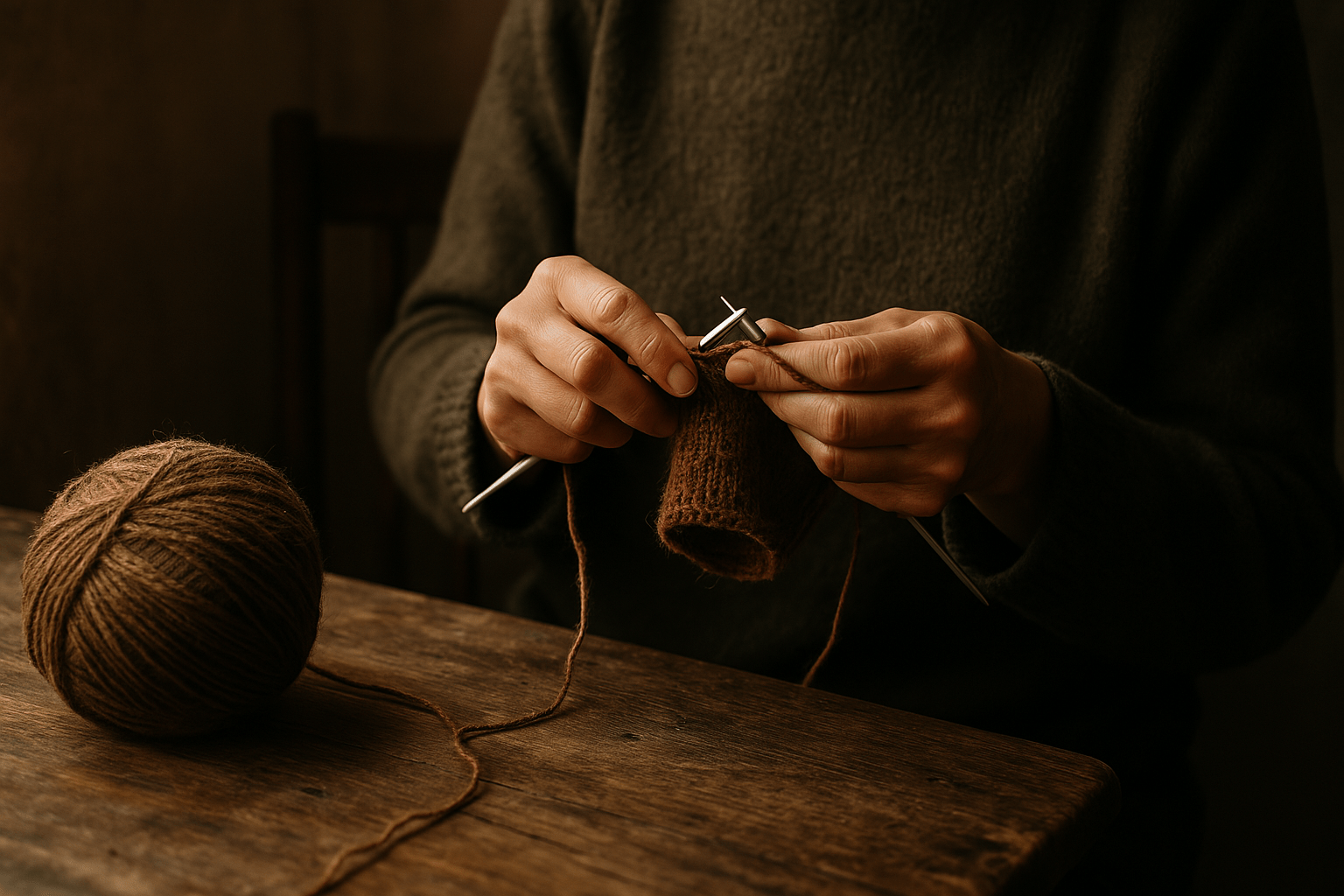
When we knit, we return to a primal connection: hands touching Material. Fingers feeling. A direct relationship to matter, without mediation by screens or algorithms. This connection is not romantic or nostalgic—it is fundamentally human.
The historian and philosopher Hannah Arendt distinguished between Homo faber (the creating human) and Animal laborans (the laboring animal). While the modern work world increasingly pushes us toward the latter—endless, repetitive tasks without visible results—craftsmanship brings us back to the essence of Homo faber: We create something lasting from our imagination.
"In a world where our hands mainly serve to scroll and type, consciously shaping with the hands is not just a leisure activity—it is a reclaiming of our human ability to shape the world rather than just consume it."
The Rebellion of Slowness
Time has become the scarcest resource. "Time-saving" is one of the most powerful sales arguments. "I don’t have time" is the universal excuse. We save time—and for what? To consume more, scroll more, react more instead of act.
Knitting fundamentally opposes this logic. It demands time. It demands patience. It demands dedication. A knitted garment takes hours, sometimes weeks or months. Its value lies in this slow creation—not just in the finished object.
This slowness is not a deficiency to overcome. It is a consciously chosen value. Every knitter knows: a Sweater can be bought much faster in a store. The decision to knit it yourself anyway is a decision for depth instead of quantity, for process instead of instant gratification.
The philosopher Byung-Chul Han describes our present as a "fatigue society," where we are constantly busy but rarely truly fulfilled. Knitting offers a counter-model: an activity that nourishes rather than exhausts us. One that does not demand we be always reachable but allows us to fully dwell in the moment.
"In a culture that worships speed, the conscious choice for slowness is not laziness—it is a form of resistance."
The Ethics of Material
We live in an era of "Fast Fashion," where clothing has become cheaper and more disposable than ever before. The social and ecological costs of this system are immense, yet often invisible.
Those who knit inevitably develop a different relationship to Material. The knitter knows the value of Wool, Silk, Mohair. She knows the Origin of the Fibers, the effort of their processing. She chooses consciously—not just by Price or current fashion.
This attention to Material leads to a deeper connection with the final product. A self-knitted Sweater is not discarded after one season. It is worn, loved, repaired, passed on. It carries history within it. It ages with dignity.
The philosopher Jane Bennett speaks of the "vitality of matter"—the realization that even seemingly lifeless objects have their own agency. The knitter experiences this vitality directly: how a Yarn feels, how it behaves, how it finds its shape over time. This experience creates a different awareness of the things around us.
"In a world of mass production, the conscious choice of Material and the careful transformation of that Material is not only an aesthetic but also an ethical decision."
The Community of Hands
The digital revolution has connected us in many ways, yet often these connections remain superficial. We "like," we comment, we share—but how often do we truly meet?
Knitting communities—whether offline in cafés and living rooms or online in forums and social networks—offer a different kind of connection. One based on shared doing, not just shared opinions. One that bridges generations. One that does not ask about status or follower count but about the common interest in craftsmanship.
The sociologist Richard Sennett emphasizes in his work "Craft" the social dimension of working together. Unlike isolated work at a screen, shared craftsmanship creates a space for genuine exchange, for passing on knowledge, for mutual support. It is not about impressing but about growing together.
"In a time of increasing social isolation, knitting communities offer something precious: connection through shared creation, not through shared consumption."
The Freedom of Independence
Our society is marked by growing dependence on complex systems we do not understand. We use technologies whose functioning we do not grasp. We wear clothing whose production conditions we do not know. We eat foods whose ingredients we cannot decipher.
Knitting—as other forms of craftsmanship—gives us back a piece of autonomy. The ability to create for ourselves what we need. The knowledge of Materials and techniques. The certainty that we are not completely dependent on the market.
This independence is not absolute—hardly anyone today spins their own Wool anymore. But it is real. It lies in the experience of one’s own efficacy, in the joy of making, in the certainty: I can create something that lasts.
The philosopher Ivan Illich coined the term "convivial tools"—tools that serve humans, not the other way around. Knitting Needles are a perfect example of such tools: simple, durable, versatile, repairable. They expand our possibilities without dominating us.
"In a world of increasing technological dependence, the ability to create complex and beautiful things with simple tools is not trivial—it is an act of self-determination."
The Meditation of Repetition
Our attention has become the most valuable currency. Countless algorithms and designs compete to captivate, surprise, and trigger us—creating a state of constant distraction.
Knitting offers a counterpoint: the calm concentration on an activity that neither blinks nor rings. The meditative quality of repeated movements. The sinking into a flow where time flows differently. Those who knit regularly know this special kind of attention—focused and relaxed at the same time.
The psychologist Mihaly Csikszentmihalyi described this state as "flow"—a complete immersion in an activity where challenge and skill are in perfect balance. In flow, we experience deep fulfillment beyond boredom and overwhelm. Knitting can be a direct path to this state.
"In an environment of constant distraction and fragmented attention, the ability to immerse oneself in an activity is not a given—it is a precious skill that must be nurtured."
The Politics of Making It Yourself
Knitting has never been apolitical. From the "Liberty Caps" of the French Revolution to the "Pussyhats" of the Women’s Marches to guerrilla knitting in public spaces—the needle has repeatedly become a tool of protest, the handmade garment a statement.
But even beyond explicit political symbols, knitting has a political dimension. In a consumer society that mainly sees us as passive recipients of pre-made Products, active creation is a statement. It says: I am more than a consumer. I have skills. I make choices.
The philosopher Martha Nussbaum speaks of the "capabilities approach"—the idea that a good life lies not in passive consumption but in the active development of human capabilities. Knitting, like other forms of craftsmanship, enables exactly this development: the growth of skill, patience, aesthetic judgment, problem-solving ability.
"In a time when consumption is often sold as the highest form of freedom, the conscious decision to create yourself rather than just consume is not only personally satisfying—it is a political stance."
The Future of Needlework
It would be a mistake to see knitting as backward-looking nostalgia. The opposite is true: as a conscious practice of slowness, material connection, and self-efficacy, knitting is surprisingly forward-looking.
In a world reaching the limits of growth, where the social and ecological costs of mass production become ever clearer, where digital overstimulation leads to new widespread illnesses—in this world, craftsmanship offers another way. Not backward, but forward: toward a more conscious use of resources, deeper social connections, a more balanced relationship between digital and physical worlds.
The philosopher and physicist Karen Barad speaks of "entanglement"—the deep interconnectedness of all beings and things. Knitting can make this entanglement tangible: how with every piece we create, we connect with the Material, with tradition, with other needleworkers, with the future wearers of our works.
"In a time of multiple crises, the quiet practice of knitting is not escapism—it is the beginning of a different relationship to the world: more mindful, slower, more connected."
At Bonifaktur, we do not see knitting as a hobby or pastime. We see it as a deep, transformative practice. As a way to reshape our relationship to the material world, to time, to ourselves. As an act of quiet resistance against the acceleration and alienation of our time.
Our Yarns, our Colors, our Patterns—they are not just Products. They are invitations to this other way of being. To a world where beauty matters more than speed. Where time is not saved but fulfilled. Where hands and heart work together.
When you knit, you are part of this quiet revolution. With every stitch you form, you weave a different relationship to the world—a relationship we need today more than ever.
Yarn with soul. For people with heart.
Why Knitting Makes You Happy Again – Even Without Perfection
Knitting Techniques Masterclass: From Beginner to Virtuoso