
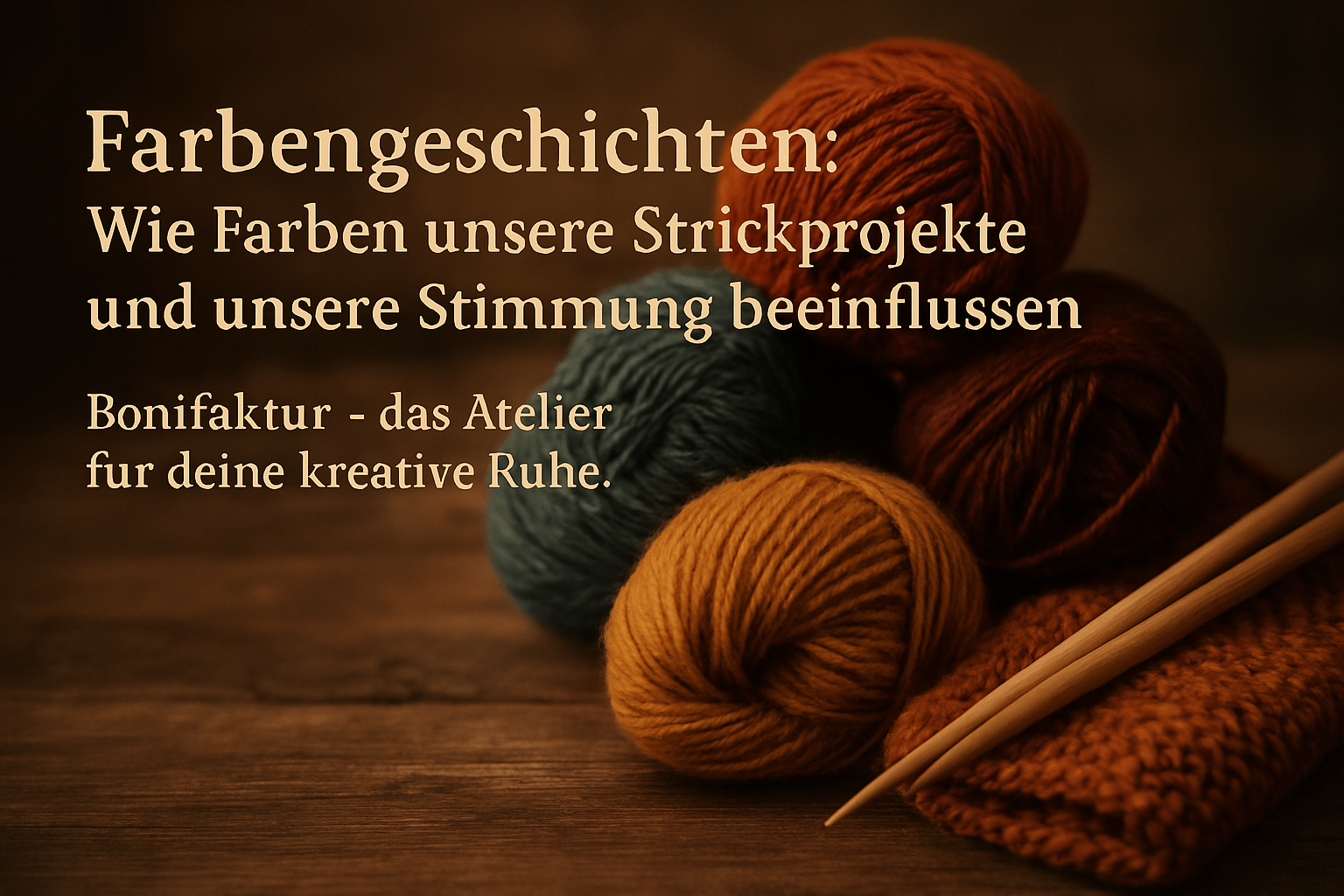
Bonifaktur – the studio for your creative calm.
There is that special moment when a yarn speaks to you. Not just through its softness or sheen, but through its color. A color that strikes a chord within you. That awakens a memory, a mood, a landscape. That won’t let go until you hold it between your fingers, thread it onto your knitting needles, and begin to transform it into something new.
Color is more than decoration or trend. It is a language that speaks directly to our emotions, opening spaces within us that words cannot reach. At Bonifaktur, we believe that the colors we choose for knitting tell deep stories about us – about our longings, our memories, our inner landscape.
This article is an invitation to dive deeper into these color stories. To understand how colors enliven our knitting projects and influence our mood. To discover how we can work more consciously with colors – not to follow trends, but to express our own inner truth.
The emotional language of colors
Long before we had words, we had colors. The first human artworks – cave paintings dating back up to 40,000 years – testify to our deep connection to colors. This connection is not only cultural but also biologically rooted. Colors influence our heartbeat, our blood pressure, even our body temperature.
Psychologist and color researcher Angela Wright describes colors as "the only visual experience that has a direct impact on our feelings." Unlike shapes or patterns, which we initially process intellectually, colors affect our psyche immediately. They are, as the artist Wassily Kandinsky put it, "a means to exert a direct influence on the soul."
In knitting, this emotional language of colors becomes especially tangible. The yarn we choose accompanies us for weeks or months. It glides through our fingers, fills our view, becomes part of our daily life. The color we choose is not just an aesthetic decision – it is an emotional companion.
Bonifaktur Reflection: Observe which colors you are drawn to in different phases of life. Are there colors that comfort you in difficult times? Colors that energize you when you need vitality? Colors that ground you when you seek calm? This personal color palette tells a story about your emotional needs and resources.
The cultural echoes of colors
Our relationship to colors is deeply woven into our cultural experience. White, which in Western cultures stands for purity and weddings, symbolizes mourning and death in many Eastern traditions. Red, which promises luck in China, warns of danger in our traffic culture.
These cultural associations are not fixed – they change over time, they blend in our globalized world. And yet they resonate within us, forming a layer of our color perception that often remains unconscious.
In Knitting, we encounter these cultural echoes in various ways. In traditional patterns where certain colors carry symbolic meaning. In fashion trends that reflect the spirit of an era. In regional preferences that express the landscape and history of a region.
Cultural anthropologist Mary Douglas describes how material objects – including our handmade textiles – carry and convey cultural meanings. A knitted piece in a certain color can establish a connection to a tradition, a community, a shared history.
Bonifaktur reflection: Are there colors that have a special meaning in your family, your community, or your personal history? Colors associated with important transitions or traditions? Consciously including these colors in your Knitting Projects can create a deep form of connection – to your roots, to shared memories, to collective meanings.
The natural language of colors
Before synthetic dyes existed, all colors came from nature – from plants, minerals, insects, shells. This connection to the natural world resonates in our perception of color, even though today we often work with artificially produced colors.
Natural colors carry a special quality within them. Unlike industrially standardized shades, they show subtle variations, slight irregularities, an inner complexity. A yarn dyed with plants carries the traces of soil and climate, of season and weather. It tells a story about its Origin, about the place and time of its creation.
Sustainability researcher Kate Fletcher emphasizes how important this connection between color and Origin is for a deeper ecological awareness. When we know the story behind a color – whether it’s the madder root that gives a deep red or the walnut shell that provides a warm brown – our relationship to this Material changes. It transforms from an anonymous product to a bearer of history and meaning.
Bonifaktur Reflection: Explore the world of natural dyes – whether through your own experiments with plant dyeing or by consciously choosing plant-dyed yarns. Observe the subtle nuances of these colors, their changes under different light, their development over time. This sensitivity to natural color nuances can open a new dimension in your Knitting work.
The Personal Palette
Each of us carries an inner color palette – colors we are repeatedly drawn to, that particularly appeal to or move us. This personal palette is as unique as a fingerprint. It is shaped by our earliest memories, our cultural influences, our aesthetic preferences, even our physiology (how we perceive colors).
Color consultant Leatrice Eiseman describes how this personal palette can be a key to authentic aesthetic decisions. Instead of blindly following trends or being guided by momentary impulses, we can explore our deeper-rooted color affinities and work with them more consciously.
In Knitting, this means finding a balance between experimenting with new colors and staying true to our personal palette. The colors we repeatedly choose are not random – they reflect something essential within us, something seeking expression.
Bonifaktur Reflection: Look at the colors in your yarn basket, in your finished projects, in your favorite pieces. Which colors keep appearing? In which combinations? These recurring patterns can give you clues about your very own color language – a language you can deepen and refine instead of drowning it out with fleeting trends.
The Interaction of Color and Texture
In knitting, we never encounter colors in isolation but always in connection with structure – with the texture of the yarn, with the pattern of the stitches, with the shape of the emerging piece. This interaction between color and structure is a fascinating area where technical skill and artistic intuition merge.
Certain colors emphasize certain structures. A complex Lace Pattern often stands out better in a solid-colored yarn than in a heavily patterned one. A multicolored yarn can bring a simple base pattern to life. A strong color contrast can enhance the three-dimensional effect of a relief pattern.
The textile designer Kaffe Fassett, known for his masterful work with colors, emphasizes how important it is to consciously experiment with this interaction. Not only through planning and calculation but through playful trying out, by placing different yarn samples side by side, by viewing them in changing light.
Craftsmanship consideration: Choose a simple pattern – such as a Ribbing or a simple Lace Pattern – and knit several small samples in different yarns and colors. Observe how the effect of the pattern changes. Which colors make the structure stand out, which come to the forefront themselves? This conscious experimenting trains your eye for the subtle relationship between color and structure.
Color Harmony
The question of which colors harmonize together has occupied people for centuries. From Goethe's theory of colors to modern color theories, there are numerous approaches to explain and systematize this harmony.
But what does harmony actually mean? Is it conformity with conventional color schemes? Is it the balance between different color qualities? Is it the emotional resonance that a Color Combination triggers in us?
The artist and color theorist Josef Albers emphasized in his work "Interaction of Color" that color perception is always relative. The same color can appear completely different depending on the environment. What we perceive as harmonious is not absolute but context-dependent – influenced by light, neighboring colors, even by our cultural background and personal history.
In knitting, this means there are no universal rules for "correct" Color Combinations. What matters is the conscious perception of how colors interact with each other, how they influence one another, how they together tell a mood or a story.
Bonifaktur reflection: Experiment with unusual Color Combinations. Place yarn samples side by side that at first glance don’t seem to match. View them in different lighting, from different distances. Sometimes a surprising, lively harmony arises precisely from the seemingly disharmonious – one that is more personal and expressive than conventional color schemes.
The Color Therapy of Knitting
The therapeutic effect of Knitting is well documented – from calming the nervous system through rhythmic movement to boosting self-esteem by creating something beautiful. But the colors themselves also have therapeutic potential.
In color therapy, different colors are attributed with various healing effects. Blue is associated with calm and inner clarity, green with regeneration and balance, yellow with mental activity and optimism. Although the scientific basis for some of these attributions is debated, many people confirm the subtle effect of colors on their well-being.
In Knitting, we can consciously use this potential. Color therapist Suzy Chiazzari describes how intense engagement with certain colors during the creative process can be a form of "active color meditation" – a way to strengthen certain emotional and mental qualities within us.
Bonifaktur reflection: Choose a color for your next Knitting Project that embodies a quality you want to strengthen in your life – whether it is calm, joy, strength, or clarity. Observe during the Knitting process how interacting with this color affects your mood and well-being. This conscious color choice can turn your Knitting Project into a kind of emotional medicine – a gentle but effective support for your well-being.
The Seasons of Colors
Our color preferences are not static – they change with our life phases, with our emotional needs, even with the seasons. Just as nature goes through a color cycle, from the fresh green of spring through the rich colors of summer to the warm tones of autumn and the quiet palette of winter, we also have inner color seasons.
Color psychologist Angela Wright describes how we seek different color moods at different times – sometimes the cheerfulness of vibrant tones, sometimes the calm of soft nuances, sometimes the depth and complexity of mixed colors.
In knitting, we can consciously embrace these natural rhythms. Instead of clinging to a fixed color palette, we can follow our changing color preferences, understand and appreciate them as an expression of our inner development.
Bonifaktur Reflection: Take time to consciously connect your yarn selection with the seasons – not in terms of fashionable seasonal colors, but in the deeper sense of harmony with natural rhythms. Which colors appeal to you in spring, which in autumn? Which projects fit which season? This conscious connection can embed your knitting in a larger natural cycle and give it an additional dimension of meaning.
The Color Story of a Piece
Every knitted piece carries its own color story within it – not only in the color of the yarn but in all the decisions that led to this color choice. What attracted you to this color? What memories, moods, hopes are connected to it?
Textile artist Sheila Hicks describes handmade textiles as "frozen thoughts" – material manifestations of our inner processes, our decisions, our creative impulses. The colors we choose are part of this story – they tell of our aesthetic preferences, our emotional states, our connections to the world around us.
A hand-knitted piece in a certain color can thus become a carrier of memories – of the time when it was made, the mood that accompanied us then, the places where we worked on it. The color becomes the anchor of these memories, a sensory key that recalls them.
Bonifaktur Reflection: Keep a "color diary" for your Knitting Projects. Note not only the technical details but also the story behind your color choice. What led you to this color? What associations, memories, feelings are connected to it? Over time, this creates a personal chronicle of your color preferences and their deeper meanings – a fascinating document of your creative journey.
The Freedom of Personal Color Voice
In a time when Color Combinations change seasonally and social media overflows with perfectly matched color palettes, it can be a revolutionary decision to follow your own color voice. Not the trends, not the rules, not the expectations – but your inner resonance with certain colors and their combinations.
Art therapist Shaun McNiff describes how the creative process – including knitting – can be a way to find and strengthen our authentic voice. Not by imitating external standards, but by following our own aesthetic truth, even if it seems unconventional.
In knitting, this means claiming the freedom to work with colors that truly move you – even if they don’t match the current zeitgeist, even if they don’t fit common color schemes. This freedom is not arbitrariness, but an expression of a deep connection to your own perception, your own story, your own creative vision.
Bonifaktur reflection: Dare a color experiment beyond your usual choice. Not to follow a trend, but to expand your personal color palette, to discover new facets of your creative voice. Sometimes it is precisely the unfamiliar that leads to surprising insights about our aesthetic preferences and their deeper meaning.
At Bonifaktur, we believe that colors are more than superficial decoration or passing trends. They are a language that speaks from heart to heart. A bridge between inner and outer worlds. A medium through which we can express our deepest feelings and longings.
We choose our yarns and colors not based on market analyses or trend forecasts, but on their ability to resonate within us. On their depth, their vibrancy, their soul. We seek colors that tell stories – not of fleeting fashions, but of timeless human experiences: of the silence of a winter morning, of the warmth of an embrace, of the depth of a forest.
When you hold a Bonifaktur yarn in your hand, we invite you to go beyond mere aesthetics. To see color as a companion on your creative journey. As a mirror of your moods and longings. As a medium through which you can express your own unique voice.
Because every color carries a story within it. And every knitter adds a new chapter to this story, with every stitch, with every piece created by their hands.
Yarn with soul. For people with heart.
Knitting as a Mindfulness Practice: The Meditative Power of Stitches
For the Masters of Stitches: 9 Knitting Tips for Advanced and Professional Knitters