


Yarn with soul. For people with heart.
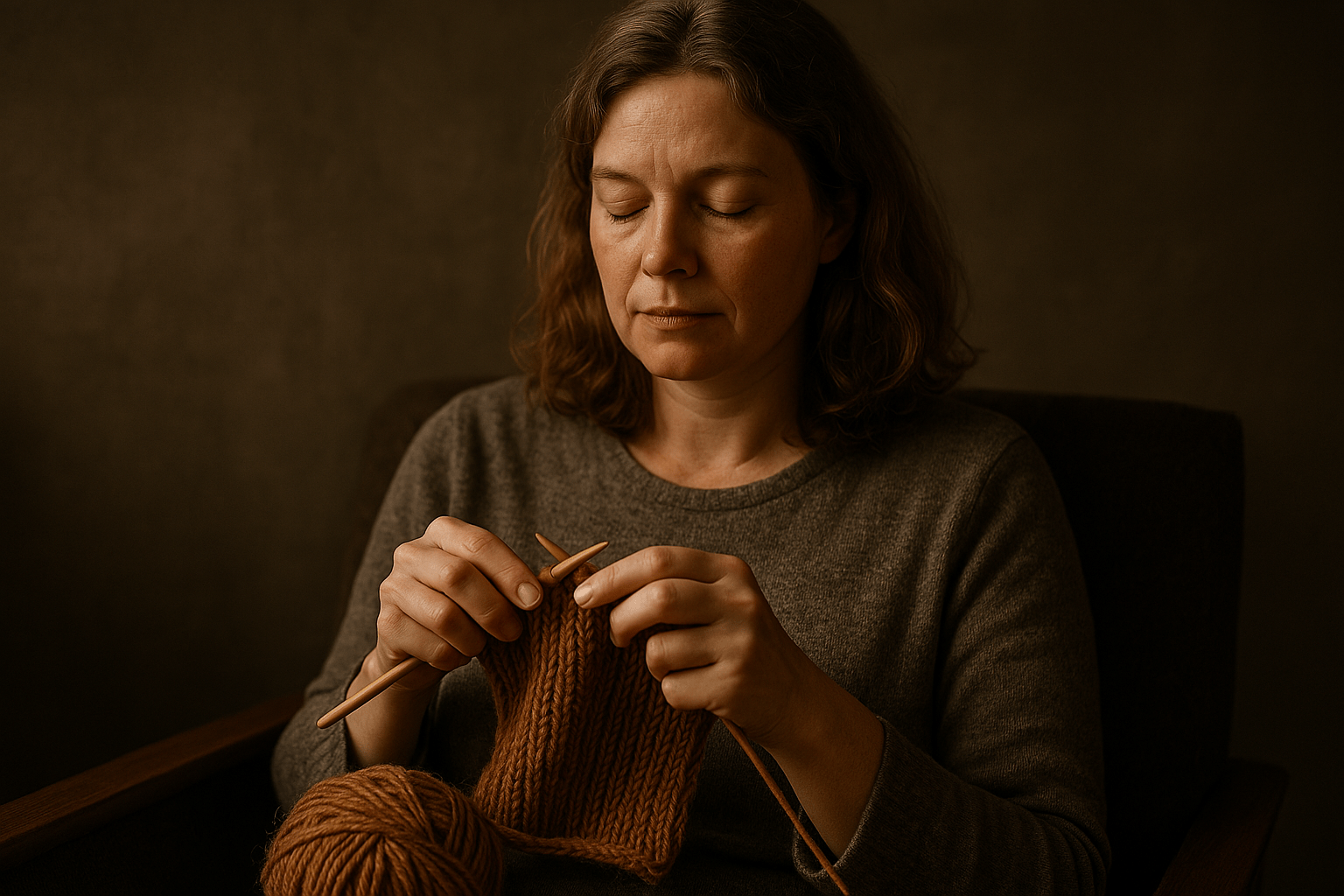
There is this special moment in Knitting when the world around us grows quieter. When the hands find their rhythm. When the breath becomes calmer. When we fully arrive in the here and now – with every pull of yarn, with every Stitch that glides through our fingers.
In a time when mindfulness is often marketed as a trendy concept, Knitting offers an original, unadulterated form of meditation. No app is needed. No course must be booked. Just hands, Needles, yarn – and the willingness to engage with the process.
At Bonifaktur, we believe Knitting is more than a hobby or a means to an end. It is a practice that can profoundly influence our well-being – a gentle revolution of attention in a time of constant distraction.
The Presence of the Hands
"The mind can only find peace where the hands are active." This ancient wisdom finds confirmation in modern neuroscience. The rhythmic, repetitive movement of Knitting activates areas of our brain associated with calm and well-being, while gently anchoring our attention in the present moment.
Unlike many other activities in our daily lives, Knitting has no separation between planning and execution, between thinking and doing. The hands know what to do. They feel the yarn, they guide the Needles, they create Stitch by Stitch. This immediate connection between intention and action creates a state of natural presence.
Mindfulness teacher and physician Dr. Judith Orloff describes this kind of "tactile meditation" as especially valuable for people who have difficulty with traditional meditation forms like silent sitting. The hands become the anchor of attention – concrete, tangible, immediate.
Bonifaktur Practice: Before you start Knitting, take a moment to feel the yarn in your hands. Its texture, its weight, its Warmth. Let your fingertips glide over the surface. This conscious touch tunes you into the presence that lies within the Knitting process itself.
The Rhythm of Breath
When we dive into the flow of Knitting, our breath changes. It becomes deeper, more even. Often, it unconsciously synchronizes with the rhythm of our hands. Inhale – pick up a Stitch. Exhale – pull the yarn through.
This natural synchronization has profound effects on our nervous system. Regular, deep breathing activates the parasympathetic nervous system – the part of our autonomic nervous system responsible for recovery and regeneration. The heartbeat slows, blood pressure drops, and stress hormones are broken down.
Meditation researcher Dr. Susanne Babbel points out that rhythmic, bilateral movements like those in Knitting can be especially effective in processing stress and even healing trauma effects. The regular alternation between right and left hand seems to promote communication between the brain hemispheres and break up stuck thought and emotional patterns.
Bonifaktur Practice: Consciously experiment with the connection between breath and knitting movement. Try to pick up one Stitch with each inhale and pull the Yarn through with each exhale for one Row or a certain number of Stitches. This conscious synchronization deepens the meditative quality of Knitting.
The Silence Between Thoughts
The human mind is restless. Thousands of thoughts pass through our consciousness daily – memories, plans, worries, fantasies. This constant inner activity is often so natural that we hardly notice it – until we try to find calm.
Knitting offers a gentle, natural way to calm this flood of thoughts. Not by forced suppression of thoughts, but by gently redirecting attention to the present moment, to the concrete activity of the hands.
The Zen teacher Thich Nhat Hanh speaks of the "anchor of mindfulness" – a concrete focal point that helps us stay in the here and now. Knitting offers many such anchors: the sound of the Needles, the structure of the emerging fabric, the color nuances of the Yarn, the movement of the fingers.
This concrete sensuality of the experience makes it easier for the mind to calm down. Not by suppressing thoughts, but by gently returning to the immediate experience whenever we get lost in thought.
Bonifaktur Practice: When you notice your thoughts drifting while Knitting, gently return to the sensory impressions. Listen consciously to the sound of the Needles. Feel the texture of the Yarn between your fingers. Observe the Colors and how they change in the light. This sensory anchoring is the core of Knitting meditation.
The Acceptance of Imperfection
One of the most valuable lessons of knitting lies in dealing with mistakes and imperfections. Every knitter knows this moment: You discover a mistake several Rows back. The temptation is strong to unravel everything and start over. But sometimes you decide to leave the mistake as is – as part of the work, as a sign of its handmade nature, as a reminder of the process.
This attitude corresponds to the core of mindfulness practice: acceptance of what is, without an immediate impulse to change or correct. The realization that imperfection is not a flaw but an integral part of all creation.
In Japanese aesthetics, there is the concept of "Wabi-Sabi" – the beauty of imperfection, transience, incompleteness. A hand-knitted piece naturally embodies this aesthetic. It is not flawless like a machine-made Product. It carries traces of the hand that created it, of the moment it was made.
This acceptance of imperfection can radiate from knitting into other areas of life. It teaches us a gentler, more loving attitude toward our own mistakes and limitations.
Bonifaktur practice: Instead of correcting every mistake immediately, take a moment to observe it. What story does it tell? What was happening inside you and around you at that moment? Sometimes it is right to fix a mistake – and sometimes it is wiser to accept it as part of the whole.
The flow of time
The modern world is shaped by a linear, fragmented understanding of time. Time is "saved," "managed," "used." We often live more in the future or past than in the present.
When we knit, we enter a different quality of time. Time is no longer measured by the clock but by the rhythm of the hands, by emerging Stitches, by growing patterns. It becomes cyclical instead of linear, flowing instead of fragmented.
The philosopher Henri Bergson distinguished between "measurable time" (temps) and "experienced time" (durée). Knitting leads us into this durée – the qualitative, inner experience of time, where an hour can pass like minutes or a moment can stretch into eternity.
This altered experience of time has profound effects on our well-being. It temporarily frees us from the tyranny of the clock and reminds us of a more original, natural way of perceiving time – one that aligns more with our inner rhythms than with external demands.
Bonifaktur practice: Knit once without a clock, without a time limit, without a goal. Not to finish a specific piece or reach a certain number of rows. Simply for the sake of knitting. Feel how your perception of time changes when you let go of the pressure to "finish."
The transformation of mood
One of the most remarkable qualities of knitting is its ability to influence our mood. Numerous studies demonstrate the calming, stress-reducing effect of this activity. The rhythmic movement, focused attention, tactile stimulation – all contribute to alleviating anxiety and enhancing overall well-being.
But knitting can do more than just soothe. It can also be a way to cope with difficult emotions. Psychologist Betsan Corkhill, who researches the therapeutic potential of knitting, describes how knitting can help regulate emotions – whether by distracting from pain sensations or by transforming turbulent feelings into creative energy.
Especially remarkable is the effect of knitting on depressive moods. The combination of rhythmic movement, successful task completion, and visible progress can have a significant impact on mood. Every completed row becomes a small success, every finished project a tangible proof of your own agency.
Bonifaktur practice: Keep a "mood journal" for your knitting. Briefly note how you feel before and after knitting. Which projects, which yarns, which patterns especially influence your mood positively? Over time, you will recognize patterns and be able to use knitting even more consciously as a tool for your emotional well-being.
The connection to the community
Mindfulness is often understood as a purely individual practice – a journey inward, a retreat from the world. But true mindfulness also opens us up to connection with others, to the fabric of relationships in which our lives are embedded.
Knitting has always had this communal dimension. From traditional knitting circles to modern knitting cafés, from online forums to charity projects – knitting connects people across generations, cultures, and life paths.
This connection has a special quality. Unlike many other social contexts, self-presentation is not the focus here, but the shared doing, mutual learning, sharing of knowledge and experience. A form of community based not on competition but on cooperation.
Sociologist Betsan Corkhill speaks of "social mindfulness" – the ability to be present in community without losing oneself. Knitting groups offer an ideal space for this form of connection: shared silence, shared concentration, a rhythm that sometimes synchronizes involuntarily.
Bonifaktur Practice: If you usually knit alone, try the experience of knitting together – whether in a local group or an online forum. Observe how your knitting practice changes when embedded in a social context. How does the community influence your rhythm, your concentration, your creativity?
Developing a Practice
Like any form of meditation, knitting unfolds its deepest effect not as an occasional activity but as a regular practice. It is not the length of each knitting session that matters, but the consistency with which we return to this practice.
Developing a knitting practice means creating a fixed place for this activity in everyday life. A physical space that invites knitting – with good lighting, comfortable seating, easy access to materials. And a temporal space – regular moments dedicated to this activity, whether in the morning before the day begins, during lunch break, or in the evening to wind down the day.
The quality of this practice lies not in the perfection of the resulting pieces, but in the attitude with which we dedicate ourselves to it. An attitude of openness, presence, and devotion to the process itself.
The Zen master Shunryu Suzuki coined the term "beginner's mind" (shoshin) – an attitude of openness, curiosity, and freedom from preconceived notions, even with advanced practice. This attitude is the key to a fulfilling knitting practice: viewing every project as a new opportunity, every stitch as a fresh moment of encounter with the Material, with the technique, with ourselves.
Bonifaktur Practice: Create a "Knitting Altar" – a place that invites you to knit. This could be a special armchair, a beautiful bowl for your current project, a basket with carefully selected yarns. A place that signals to you: Here is space for presence, for creativity, for depth.
The Transfer into Everyday Life
Perhaps the most valuable dimension of Knitting as a mindfulness practice lies in its ability to extend beyond the actual Knitting time. The qualities we cultivate while Knitting – presence, patience, acceptance, focus – can gradually flow into other areas of life.
Psychologist Ellen Langer, a pioneer in mindfulness research, describes mindfulness not as an isolated exercise but as a fundamental attitude of openness and attention to new information. An attitude we can cultivate in any activity – from washing dishes to conversation, from walking to working on the computer.
Knitting can be an entry point to this mindful way of life – an activity that, through its sensual concreteness and natural rhythm, is especially suited to bring us into the present moment. A practice that allows us to experience and deepen the quality of attention that we can then carry into other areas of life.
Bonifaktur practice: Try consciously transferring the quality of attention you feel while Knitting into an everyday activity – whether it’s preparing a meal, walking a familiar route, or listening to a conversation. Observe how the experience of that activity changes when you give it the same present attention as your Knitting Project.
At Bonifaktur, we see Knitting not just as a hobby or craft but as an art of living. A practice that helps us stay present in an accelerated world. That allows us to connect through our hands with a deeper layer of being. That reminds us of what truly matters: not perfection, but presence. Not quantity, but quality. Not speed, but depth.
Our Yarns, our Colors, our Patterns are more than Products – they are invitations to this practice. Tools for a journey that leads not only to beautiful objects but to a deeper connection with ourselves, with the Material, with the moment.
In a world constantly chasing the new, the fast, the efficient, the calm focus of Knitting is not old-fashioned – it is revolutionary. A gentle but effective rebellion against the distraction of our attention, against the alienation of our hands, against the loss of the moment.
Knitting is meditation in motion. A practice of presence, Stitch by Stitch.
Where every Stitch is a choice for beauty.
Animal and plant Fibers
Color Stories: How Colors Influence Our Knitting Projects and Our Mood